
Weddings

Professional events
.svg)
Weddings
Professional events
What is a seminar? 4 key steps to define, choose, and run a successful one

What is a seminar? Behind this word, often heard in professional or academic circles, lies a multifaceted reality associated with a wide range of goals and formats. Whether it’s a corporate meeting focused on team cohesion, a university session devoted to research analysis, or a spiritual retreat, a seminar is above all a structured moment of exchange, learning and reflection. This article offers a clear, step-by-step exploration of the concept, untangling its different dimensions according to the contexts in which it applies. To go further, it is useful to clarify its basics and boundaries.
What is a seminar: definition and basic concepts
General definition of the word “seminar”
What exactly is a corporate seminar? A seminar refers to a structured professional meeting that brings a group of people together around a specific theme. This corporate gathering aims at learning, discussion or collaborative work within organizations. Participants, generally in small numbers, actively exchange ideas over a few hours to several days during this corporate event.
In an academic context, what is a university seminar? Advanced students analyze research under the guidance of a professor as part of a university seminar.
In the professional world, what is a training seminar? It is an intensive educational event intended to convey in-depth knowledge to teams. Expert speakers share their know-how during these working sessions. Participants develop targeted skills through exchange and practice, which is the appeal of the modern seminar. Alongside these uses, the etymology of the term provides useful insight.
Origin and etymology of the term “seminar”
This definition of a seminar becomes fully meaningful when you understand the word’s origin. Seminarium in Latin means “nursery.” The term derives from semen, “seed” or “vital principle.” Introduced in the 16th century, what was a religious seminar at that time? It originally referred to institutions training future priests. The Council of Trent then institutionalized the major and minor religious seminaries.
In the 17th century the usage broadened: “France is a true nursery of war giants.” In the 19th century the German Seminar was borrowed for university groups. This agricultural metaphor persists in the organization of the modern seminar: knowledge is “sown” so it can “grow” within participants. The concept even inspired Jacques Lacan’s Seminar film, exploring the psychoanalytic dimensions of teaching. These lineages still illuminate current formats.
Common characteristics of all types of seminars
These historical roots are reflected in the characteristics shared by all modern seminar types, whether a working seminar or a motivation seminar:
- A professional gathering of a group of participants (employees, managers, collaborators), often held outside the usual premises to encourage disconnection
- Seminar objectives clearly defined in advance: training, team cohesion through team-building activities, strategic planning, or product launches
- An alternation between work periods and moments of relaxation that maintain attention and strengthen human bonds during the seminar
- An interactive format with exchanges, professional workshops, and small-group presentations that stimulate creativity and collaboration
- Structured logistical organization of the internal seminar: an accessible venue with technical equipment, appropriate duration, and regular breaks
- Communication and collective problem-solving, perfectly illustrating a seminar’s role in the modern company
Difference between seminar, conference, workshop and symposium
These characteristics distinguish the professional seminar from other corporate event formats. A typical seminar combines training and exchange for a small group with moderate to strong interaction. Companies use this seminar format for strategic alignment or developing specific skills. A corporate conference presents knowledge to a wide audience through one-way speeches; interaction is usually limited to a final Q&A. A workshop emphasizes practice with concrete exercises and required active participation. A symposium brings together selected experts to debate and decide collectively. Each format answers a different need: wide dissemination (conference), in-depth training (training seminar), practical learning (workshop) or expert debate (symposium).
How to choose the right type of seminar?
Depending on the intended objective, variations can be significant.

Different types of seminars (professional, training, academic, religious)
To understand what kind of corporate seminar suits your needs, you must first identify the different existing categories. Professional seminars aim to improve employees’ skills and facilitate networking. They include specific training sessions, team building or motivational sessions. Training seminars develop targeted professional skills through intensive educational sessions. But what is a university seminar? University seminars bring students and researchers together around presentations of research work and academic discussions. For those wondering what a religious seminar is, it is a gathering of a community around spiritual themes and theological reflection. Each type serves distinct seminar objectives with a specific audience. There is even the film seminar, an innovative format using video to convey messages. On this basis, it becomes easier to examine corporate organization.
Corporate seminar: objectives, types, organization
The definition of a corporate seminar goes beyond a simple company event to pursue several strategic objectives. The role of a professional seminar is multiple and structuring. The following elements frame the key objectives and modalities.
- Strengthen team cohesion: taking employees out of their usual environment through team-building activities improves collaboration during the internal seminar.
- Promote professional development: what is a training seminar if not educational sessions that allow participants to acquire or deepen essential skills through professional workshops.
- Define company strategies: mobilize teams around a common project or a new strategic direction during a structured professional meeting.
- Main types: cohesion seminar (team building), strategy seminar (directions and decisions), training seminar (skills development), onboarding seminar (new employees), management seminar (review and planning), commercial seminar (sales objectives), incentive or motivation seminar (in an offbeat setting).
- Concrete organization of a seminar: define the seminar’s purpose, identify participants for the corporate gathering, choose a suitable venue outside regular offices, establish a realistic budget, and plan the program with working sessions and activities.
University seminar: structure and specifics
The university seminar is clearly distinct from the typical working seminar by its unique structure. It brings together 10 to 30 participants around a specific research theme in an academic setting.
The interactive format encourages discussion and the clash of ideas in each working session. Sessions run over several semesters with individual work, guided readings and student presentations. The research orientation develops critical thinking on specialized questions. Participants produce research papers, theses and critical presentations. This academic approach contrasts with professional seminar types focused on practical training or team cohesion.
Typical format and duration of a seminar
The course of a seminar varies according to the structures, which naturally determine possible temporal formats. A half‑day seminar (3–4 hours) suits product presentations or quick updates.
A full-day in-person seminar (6–8 hours) allows for project launches, team reviews and cohesion workshops with a closing cocktail.
A residential seminar over 1.5 to 3 days offers total immersion with a mix of plenary sessions, workshops and informal activities.
Micro-seminars of a few hours are used for urgent communications. Hybrid formats alternate between in-person and remote participation for multisite teams.
Exceptional week-long events create memorable experiences to reward teams during an ambitious corporate seminar. Beyond format, success depends on orchestration.

Organizing a successful seminar
To move into action, a few reference points are essential.
The role of participants and facilitators
Understanding what a corporate seminar is starts with identifying the key actors. The facilitator orchestrates the corporate event by managing the schedule, launching activities and maintaining group engagement. Their ability to adapt to participants’ reactions turns a simple professional meeting into a rewarding collaborative experience.
Participants in a professional seminar are not passive spectators. They ask relevant questions, share ideas and collaborate actively during professional workshops. Their involvement directly determines the quality of exchanges during the working session.
Careful preparation beforehand makes their participation at the corporate gathering easier. The facilitator fosters a safe environment to encourage reserved individuals to speak up. This synergy between dynamic facilitation and active participation determines the success of the working seminar. The two roles influence each other to achieve the objectives of an effective seminar.
Typical organization and proceedings
The flow of a seminar follows precise steps that ensure its success, whether it’s a training seminar or a motivation seminar.
- Definition of objectives and target audience: Clarifying the goal (training, cohesion, onboarding) guides the choice of format for the internal seminar. Identifying who will participate (employees, partners, clients) allows adapting the content for this corporate session.
- Budgeting and venue selection: Anticipating all expense items prevents overruns when organizing a seminar. The venue must suit the seminar’s objectives: an inspiring setting for creativity, a professional room when a university-style seminar requires concentration.
- Creation of a detailed reverse schedule: List all tasks from sending invitations to technical checks. Each person in charge knows their deadlines for this corporate seminar.
- Planning a balanced program: Structure the days with sessions, breaks, meals and team building activities. Alternating work and relaxation maintains attention during the professional seminar.
- Communication and mobilization: Send personalized invitations with the theme, objectives and logistical information. Creating a WhatsApp group facilitates real-time exchanges during the corporate event.
- Welcome and facilitation on D‑day: Ensure a smooth welcome, distribute badges and documents. Supervise sessions and handle unforeseen issues with prepared backup solutions.
- Collecting feedback and follow-up: Gather feedback via questionnaires to measure satisfaction. Conduct a debrief to capitalize on the experience for future events, thereby consolidating the value of a well-organized seminar.
How to choose a seminar suited to your needs
Selecting the appropriate format according to precise criteria guarantees success, whether for a university seminar or a corporate seminar example. To choose well, several criteria guide the decision:
- Identify your primary objectives: strengthening cohesion requires a team-building activity like an escape game or cooking workshops. Training demands technical sessions with adapted materials, illustrating what an effective training seminar is.
- Analyze the organizational context: internal tensions point toward collaborative activities. A need for innovation favors brainstorming sessions in an inspiring venue, thus defining the role of an adaptive seminar.
- Evaluate logistical constraints: available budget, number of participants and timing determine possibilities. A two-day strategic seminar requires equipped rooms and accommodation, unlike a religious seminar which often favors simplicity.
- Adapt the format to the participants’ profile: age, interests and hierarchical level influence activities. Mixing lectures and workshops maintains engagement during this collaborative working session.
- Choose the venue according to the desired atmosphere: a formal setting for a commercial seminar, a relaxed natural site for team cohesion. The definition of a successful seminar depends on matching venue and objectives.
Advantages and usefulness of seminars
The concrete benefits justify the investment of time and resources for any type of seminar, from a creative film seminar to a classic professional meeting.
Advantages:
- Strengthening cohesion through shared activities that create common memories during the professional workshop
- Improved communication between departments thanks to cross-functional exchanges at the corporate gathering
- Skill development via workshops that contribute to performance, illustrating the objectives of a training seminar
- Stimulation of innovation through a change of environment that encourages new ideas
- Increased employee motivation boosting engagement and sense of belonging to the company seminar
- Strategic alignment by communicating vision and future objectives during the internal seminar
- Creation of a calmer social climate that improves dialogue and collaboration after the event
Disadvantages:
- Financial cost including venue, accommodation, catering and activities for the corporate event
- Time away from daily work that can affect immediate productivity
- Organizational complexity requiring rigorous planning and coordination of the professional seminar
- Risk of disengagement if objectives are poorly defined or the program is unsuitable for the chosen seminar type
- Logistical difficulties in bringing all participants together on the same dates, especially for a large-scale motivation seminar
These observations take on a new dimension with digital technology.
Seminars in the digital age
Evolution with digital technology (webinars, hybrid formats)
While traditional seminars require physical presence, digital technology is radically transforming this approach. Webinars now make it possible to reach up to 10,000 participants simultaneously, as offered by platforms like ClickMeeting. This revolution goes beyond simple video conferencing and redefines what a modern seminar is.
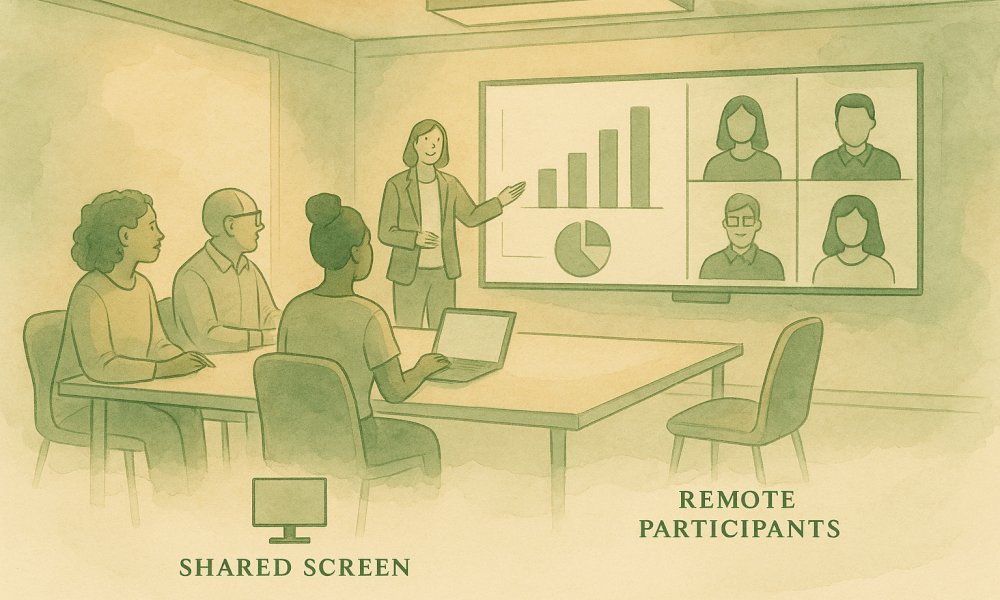
Hybrid formats combine physical presence and remote participation, creating a unified experience for all attendees. Travel costs disappear and geographic barriers fade, which explains why the corporate seminar is evolving toward these new modalities.
Virtual reality enhances learning by making content interactive and immersive. Recordings extend the life of corporate events, allowing each participant to review content at their own pace. This flexibility improves knowledge assimilation and perfectly answers the question “what is a training seminar” in the digital era. A seminar’s role is thus expanded, offering new possibilities for organizing a seminar adapted to current needs. In this dynamic, it becomes easier to find the right event.
Resources for finding a seminar
Digital transformation also makes it easier to find suitable seminars, whether a professional seminar, a university seminar or a collaborative working session. Here are the main resources available to understand what a university seminar can offer and how to find one:
- Specialized platforms: ALEOU offers 12,900 venues with negotiated pricing services for organizing a working seminar. FCM Venue Finder provides access to 250,000 global spaces with sustainability criteria, perfect for a corporate conference or a professional workshop.
- Webinar solutions: Zoom and Microsoft Teams enable interactions, screen sharing and breakout rooms, essential for running an internal seminar. Glowbl promotes networking in subgroups, ideal for a team-building activity and team cohesion during a corporate gathering.
- Event portals: Eventbrite lists conferences and workshops by interest, perfectly illustrating the goals of a motivation seminar. Webikeo hosts 5,000 free professional webinars, offering an accessible seminar example for continuous training and demonstrating the value of seminars in professional development.
- Academic sites: Domuni‑Universitas offers interactive asynchronous e‑seminars, addressing those who wonder what a modern religious seminar can be. Sciencesconf.org freely manages online colloquia and scientific workshops, illustrating the different seminar types available in academia and their role in enriching professional meetings.
To properly answer the question “what is a seminar?” you must grasp its many facets, whether professional, academic or spiritual. Beyond a simple gathering, these events bring together people committed to a common objective in a process of exchange, reflection and collective progress.
Whether through an intensive training seminar, a strategic corporate meeting or a university session devoted to research, each format finds its relevance according to the needs of the target audience. In all cases, success rests on rigorous organization, clearly defined objectives and a participatory dynamic.
The development of hybrid and digital formats now opens the way to even more inclusive and flexible experiences, highlighting this device’s adaptability in the service of learning and collaboration.


Weddings
Professional events